Es Devlin, or the Impossible Museum
At the Design Museum, Anastasia Lander explored a retrospective of an artist whose work is built to disappear.
If there’s a woman whose name is heard more in my household than mine or our daughter’s, it’s Es Devlin.
My husband, who creates immersive experiences, has long been infatuated with the famous artist and designer. Es Devlin, the High Priestess of shows and spellbinding spaces, has become a fixture at the Landers’. I’m not jealous. In fact, after seeing Es Devlin: Other Worlds, her first European retrospective, which recently opened at the Design Museum in London, I think every Briton should be able to see this exhibition. First, I’m convinced Ms Devlin is a national treasure. Second, a stage designer's work is short-lived by nature, and this show is a rare chance to experience or relive it.
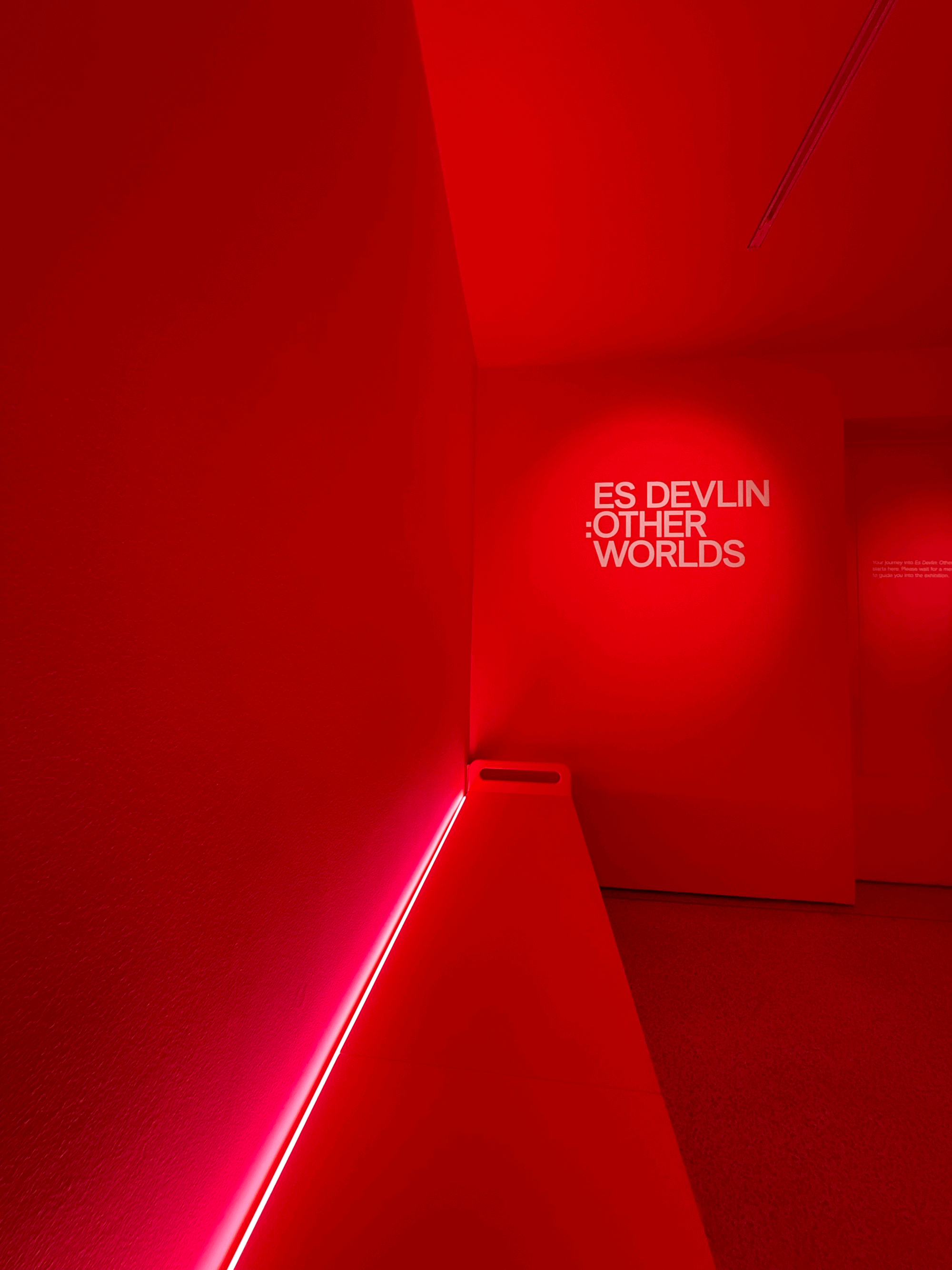
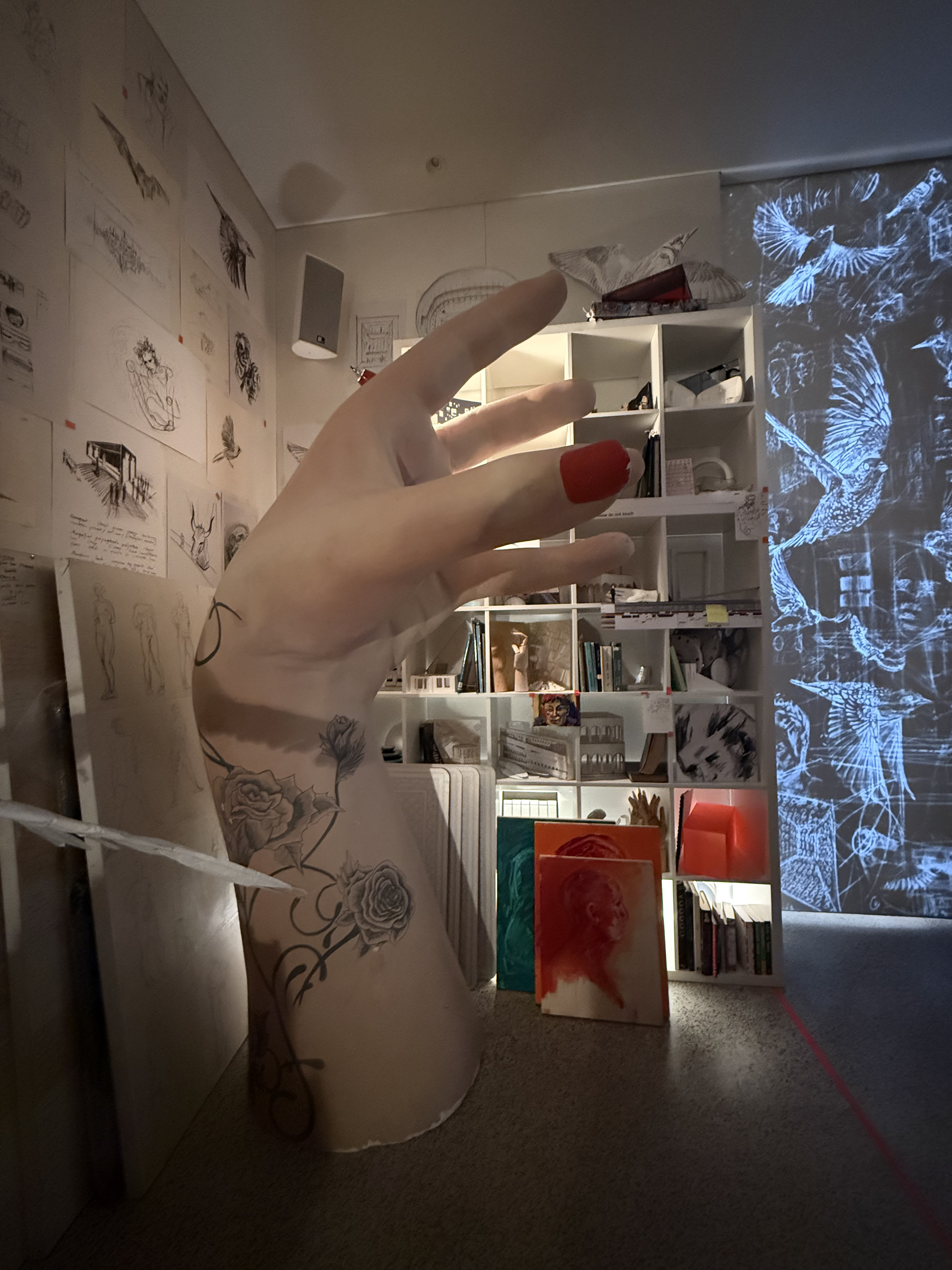
The exhibition, which is a distant cousin of An Atlas of Es Devlin, her 2023–24 show at the Cooper Hewitt in New York, is breathtaking, albeit rather compact. For me the show ended too quickly, as if I’d hit a wall. I certainly could have kept going for at least a couple more rooms. The entry to Es Devlin: Other Worlds is an unsettlingly neon-lit waiting area in bright red, a colour Devlin uses for dramatic transitions. The congregation waits on benches until it is ushered into the artist’s realm. Devlin is a guru of liminal spaces and plays every threshold for all it's worth. Once through the little red door, we find ourselves in the artist’s studio, with all the chaos and charm of a multihyphenate's workshop. Walls and walls of labelled drawers, overflowing with arts-and-crafts treasure, shelves packed with books, 3D models and mock-ups, Lilliputian and gargantuan, such as a tattooed female hand, a maquette for the set of Carmen, staged in Bregenz in 2017-2018 by Kasper Holten. Sketches, sketches, and more sketches – Devlin is a brilliant draughtswoman; her pencil gets an idea onto paper fast. We take a seat again and watch a short film showcasing the artist’s hands rummaging through drawings, fiddling with notebooks, folding scraps of paper, leafing through notes made in solemn, medieval handwriting, while her low calm voice tells the story of how her career – or, rather, her way of constructing the world – came to be. She dabbled in many things, drew countless figures within ultimately the same space of a cube, studied English literature and fine art when someone brought her to a theatre workshop and she knew she could create worlds – within cubes and beyond – and populate them with people. Over three decades, that world-building has settled into a toolkit: the ever-present rotating cube, the memory-palace technique of storing ideas in imagined rooms, and research that is often rooted in etymology.
Her creations, Devlin remarks in almost every interview, have a very short lifespan: from a 15-minute fashion show to a couple of seasons at most. To engage with the public, which Devlin considers a “temporary society” emerging in each runway show, play, concert or public artwork, she builds shared experiences, based on emotions, highly sensorial and visually striking.
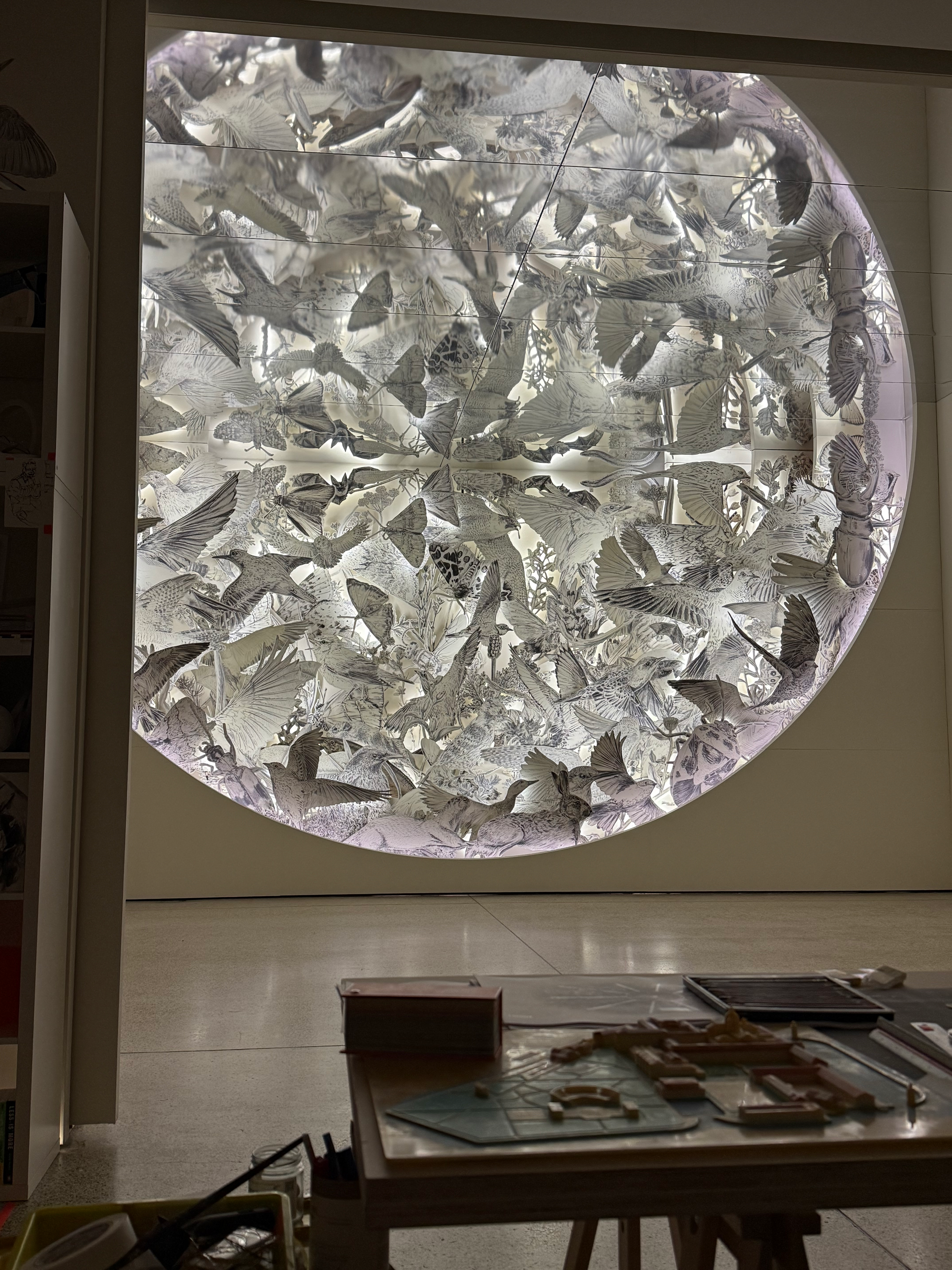
We are indeed struck when another door opens onto Come Home Again, Mirrored, a huge paper-and-ink diorama depicting 243 London species of flora and fauna from the capital’s priority conservation list. Commissioned by Cartier and made with guidance from the London Wildlife Trust in 2022, the artwork is a poetic and powerful kick in the gut. Endangered moths, hares, fish, flowers, beetles swarm in a circle dance under a mirrored ceiling. I proceed to the next room thinking about paper ducks, hares, butterflies with a mixture of shame and tenderness.
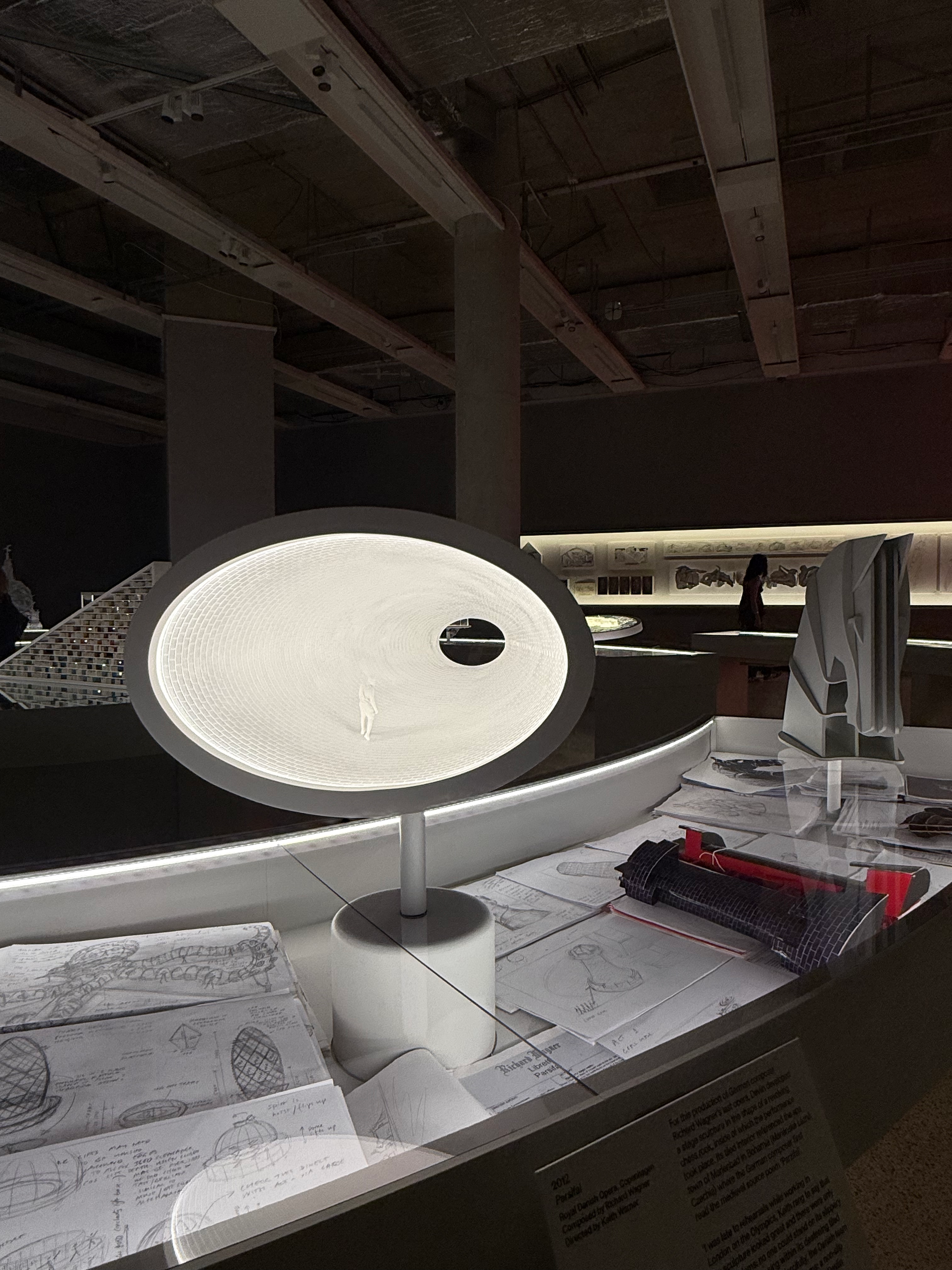
The next room features the 30-Year Desk, a maze of vitrines packed with three decades worth of sketches, 3D models and revolving boxes. Walking through this labyrinth feels like touring her memory palace. The cube is the room she returns to most. The laconic form allows her to simplify a concept, reduce it to the most important components and then build a universe inside, unfolding in a myriad of possibilities. Here’s an origami version for a Pet Shop Boys concert in 2009. Here’s Chimerica for the Almeida Theatre in 2013 and The Lehman Trilogy for the National Theatre in 2018. But a signature move can harden into a habit. Her Don Giovanni for the Royal Opera House, first staged in 2014, sets the plot's intrigues on the floors of a revolving cuboid, its rooms connected — or separated? — by doors and staircases. Twelve years ago it was a revelation. When the Royal Opera opened the autumn season with it this year, I caught myself bored 30 minutes into the first act, despite my love for both Devlin and Mozart. Have we seen too many revolving houses lately? The magic now reads as a trick. What still works, though, is a set design originating from the performer or character. Such are Carmen’s tattooed hands, Adele’s mesmerising eyes or Miley Cyrus’s playful tongue. Devlin loves to dismember her heroes, then transpose their power into gigantic relics the crowd will venerate in the span of a show.
We move towards the last room, where An Infinite Library, a new kinetic sculpture featuring over 2,000 books that have shaped Devlin’s worldview, solemnly revolves on a huge mirror. The shadows of Aristotle, Borges, Eco and the like seem to emerge from the mirror, while we leaf through the dog-eared and pencil-marked tomes, offered for perusing on stools surrounding the installation. Oh, to stay forever in a clever, well thought-through, surreal and beautiful world of Devlin's making, with a good book! Alas, exit is imminent, through the gift shop, stocked with a limited Wallpaper* edition featuring a concertina cover, and A Concise Atlas of Es Devlin, the artist’s monograph full of sketches, drawings, essays and photo documentation of her iconic productions.
As I exit, my husband and I agree that the only way to make this retrospective better is to make it permanent. Which is the one thing Devlin's work is not. It is so fascinating because it vanishes, and a crowd's shared power can only manifest in a carefully staged but fleeting moment. Still, we want a hangar with a rotating sequence of Devlin’s set designs, resurrected for perusal – or better, a theme park, like the Warner Bros. Studio Tour with an eternal Hogwarts! I want to slide down Miley Cyrus’s tongue, scale a Don Giovanni staircase, ride the lift of the Muse Resistance tour, crawl inside the Trojan horse, get excited, sad, scared and awed – in no particular order – with a temporary society next to me, for as long as it lasts.
Credit: Es Devlin: Other Worlds. 2 October 2026 – 4 April 2027. The Design Museum. designmuseum.org/exhibitions/es-devlin-other-worlds